



FAQ
OPAC is malfunctioning. (OPAC recommended browsers and guidelines)
Recommended Browsers
To ensure optimal use of the OPAC, we recommend using the latest version of the following browsers:
Windows
- Microsoft Edge
- Mozilla Firefox
- Google Chrome
Macintosh
- Safari
Note
The system may not function correctly if the following settings are enabled. If this applies to you, please adjust your settings accordingly.
- If cookies are disabled
What can I search for in the OPAC?
The OPAC has tabs corresponding to different search targets. Each tab is for:
・Bib Search: Books and journals held by this library
・Articles: Accessible domestic academic articles, etc.
・Other Univ.: Books and journals held by university libraries across the country
・Cross-Search: Materials held by the National Diet Library, public libraries, etc.
Please tell me how to use each database, how to search for materials, and how to make the most of the library.
Please refer to the page below:
How to Find Materials (Library Website)
I am looking for a specific item called "○○". What should I do first?
1.If the material you are looking for is a book:
You can search for it using the Library Catalog. Please perform your search using the [Book Search] tab.
If you cannot find the material in the Library Catalog, it is possible to request it from another university library. You can look for materials held by other universities using the [Other University Search] tab or the [Cross-Search] tab.
In the [Cross-Search] tab, you can search the collections of regional libraries and the National Diet Library. The National Diet Library makes efforts to archive every book published within Japan.
2.If the material you are looking for is a journal:
The basic procedure is the same as for books.
However, in the case of journals, there are physical copies (printed volumes) held in the library, and electronic journals (e-journals) that can be accessed via computer through contracts with publishers and other providers. If you are looking for e-journals, it is convenient to use the [Articles] tab.
3.If the material you are looking for is an academic article:
Please perform your search using the [Articles] tab.
How can I search using ISBN or ISSN numbers?
You can search by entering only the ISBN or ISSN number into the search box on the [Library Catalog] tab.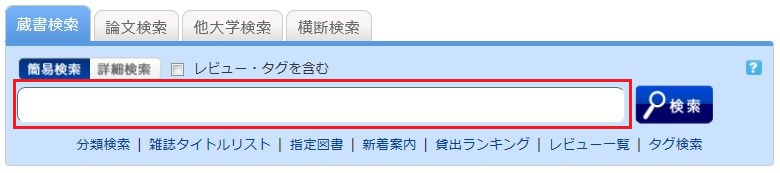
Alternatively, you can search from the advanced search screen by clicking the [Advanced Search] button on the [Library Catalog] tab.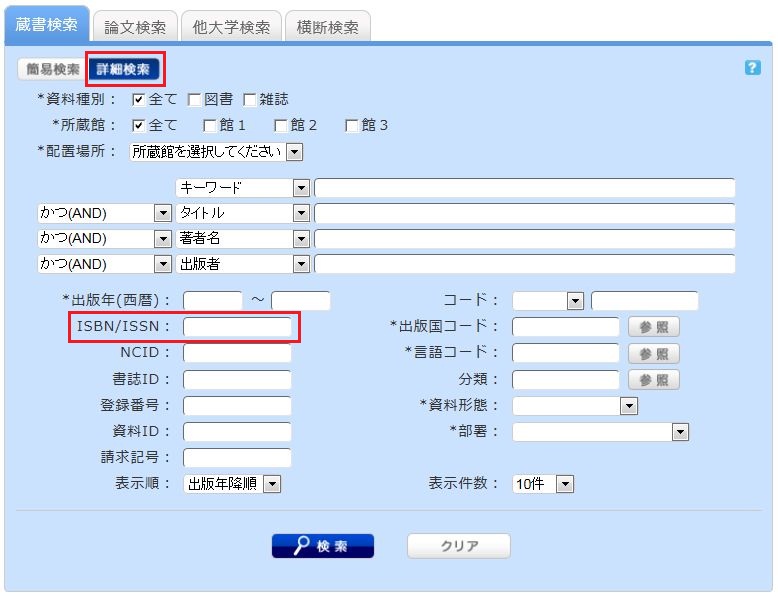
You can perform a search by entering the information in the ISBN / ISSN field.
ISBN (International Standard Book Number): A number used to identify books.
ISSN (International Standard Serial Number): A number used to identify journals/serials.
What characters can I use in the [Book Search] tab?
Available Characters
The characters that can be used on the Japanese version of the page are Kanji, Hiragana, Katakana, and alphanumeric characters. You can enter English letters in either uppercase or lowercase. You may also use either full-width or half-width characters.
Searching for Arabic, Devanagari, African, and Southeast Asian scripts
You can search using the original spelling (the script as it appears in the material), but you can also search using keywords romanized into the Latin alphabet according to the ALA-LC Romanization Tables provided by the Library of Congress. Since some materials are cataloged only with romanized Latin alphabet text, if you do not get any results with the original spelling, please romanize the terms and try searching again.
How should I search if I don't remember the exact title?
When you type a partial keyword on the [Library Catalog] tab, a list of candidate materials starting with the entered string will be displayed (Suggest feature).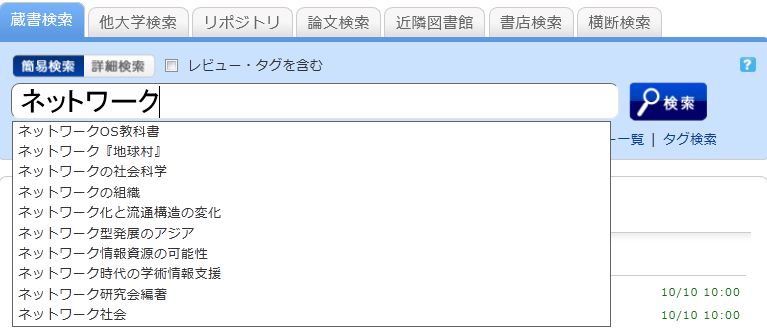
Select one from the displayed candidates and click the [Search] button to start the search.
How can I combine multiple search criteria? (e.g., searching for items containing "○○" or "△△")
You can perform the following three types of searches (logical operations) by entering multiple search terms into a single search field or by entering terms into multiple search fields.
When entering multiple search terms into a single search field (Available in both Simple Search and Advanced Search screens)
AND Search
- : Searches for materials that satisfy two or more search terms simultaneously.
- How to enter: Connect each search term with a " " (space).
- Example: To search for materials that contain both "Japan" and "America":
- "Japan America"
OR Search
- : Searches for materials that satisfy at least one of two or more search terms.
- How to enter: Connect each search term with a "+" (plus sign).
- Example: To search for materials that contain either "Japan" or "America":
- "Japan+America"
NOT Search
- : Searches for materials that satisfy a certain condition while excluding those that meet other conditions.
- How to enter: Connect each search term with a "^" (caret sign).
- Example: To search for materials that contain "Japan" but not "America":
- "Japan^America"
When entering search terms into multiple search fields (Available in the Advanced Search screen)
AND Search
- : Searches for materials that satisfy two or more search terms simultaneously.
- How to enter: Enter search terms into multiple fields and select "AND" from the pull-down menu between the fields.
- Example: To search for materials where the title contains "Japan" AND the author name contains "Tokyo":
- Title: Japan
Pull-down menu: AND - Author Name: Tokyo
NOT Search
- : Among materials that satisfy one condition, this excludes those that satisfy another condition.
- How to enter: Enter search terms into multiple fields and select "NOT" from the pull-down menu between the fields.
- Example: To search for materials where the title contains "Japan" but the author name does NOT contain "Tokyo":
- Title: Japan
Pull-down menu: NOT - Author Name: Tokyo
Primary and Secondary Search Fields
The following are called primary search fields, which can be used to perform a search independently using only their search terms.
- Keyword
- Title
- Author
- Publisher
- Subject
- Review
- Tag
- Classification
- ISBN/ISSN
- NCID
- Bibliographic ID
- Accession Number
- Material ID
- Call Number
The following are called secondary search fields, which cannot be used for a search unless combined with one or more primary search fields. On the search screen, these fields are marked with an asterisk (*) before their names.
- Material Type
- Library
- Publication Year
- Country of Publication Code
- Language Code
- Location
- Material Format
- Department
Useful symbols for [Book Search] (How can I search for items starting with "○○" or ending with "○○"?)
There are two search methods available: Keyword Search and Literal Search.
- In a Keyword Search, the system searches for materials that contain the entered search value as a word (= keyword).
In a Literal Search, the system searches for materials that contain the entered search value simply as a string of characters (= literal).
You can specify the following search methods for Literal Search:
Search Method Description Input Example Match Example Exact Match Searches for materials that exactly match the entered search string. end end END End Starts With Searches for materials that start with the entered search string. end* ending Contains Searches for materials that contain the entered search string. end weekends Ends With Searches for materials that end with the entered search string. *end weekend
- The following search fields are usually searched using Keyword Search. To perform a Literal Search in the keyword search fields listed below, please add a "#" at the beginning of your search value.
Keyword Search Fields- Title
- Author
- Publisher
- Subject
- Keyword
- The following search fields are usually searched using Literal Search.
Literal Search Fields- Publication Year
- Classification
- ISBN/ISSN
- Country of Publication Code
- Language Code
- NCID
- Accession Number (Starts with match only)
- Material ID (Starts with match only)
- Call Number (Starts with match only)
By using Literal Search, you can set search conditions in detail as follows:
Search Method Input Example
(Field: Search Value)Match Example Search for materials where the title contains the keyword "Nihon" (Keyword Search) Title: Nihon History of Nihon
Folktales of Nihon
America and NihonSearch for materials where the title is "Nihon" (Literal Search) Title: #Nihon Nihon Search for materials where the title ends with "Nihon" (Literal Search) Title: #Nihon America and Nihon
Rebirth of Nihon
NihonSearch for materials published in the 1900s (Literal Search) Publication Year: 19 1945
What search fields are available on the [Book Search] advanced search screen?
On the Advanced Search screen, you can search using the following fields.
- In the input examples, "△" represents one or more spaces.
- [Local] indicates search fields that are valid only for local searches. When performing an NII search, the values entered in these fields are ignored.
| Search Field | Description | Input Example / Targeted Materials |
| Material Type | Narrows the search by material type. | Check the checkboxes for material types such as "All," "Book," "Journal," etc. |
| Campus Library [Local] |
Narrows the search by campus or library. | Check the checkboxes for the target campus or library. |
| Location | Selects a location from the pull-down menu to search. | Ex: Main Library 1F |
| [Local] | Materials located in the Main Library 1F | |
| Keyword | Searches all fields: title, author, and subject. May result in a large number of hits. | Ex 1) Nihon△Tanaka△Politics |
| Materials containing "Nihon", "Tanaka", and "Politics" anywhere in the title, author, or subject. | ||
| Ex 2) Nihon+Politics | ||
| Materials containing either "Nihon" or "Politics" anywhere in the title, author, or subject. | ||
| Ex 3) Nihon^Politics | ||
| Materials containing "Nihon" but NOT "Politics" anywhere in the title, author, or subject. | ||
| Ex 4) #Nihon no Politics | ||
| Materials where the title, author, or subject is exactly "Nihon no Politics". | ||
| Ex 5) #Nihon no Politics | ||
| Materials where the title, author, or subject ends with "Nihon no Politics". | ||
| Title | Searches titles, journal names, series titles, etc. | Ex 1) Nihon no Politics |
| Materials containing "Nihon", "no", and "Politics" in the title. | ||
| Ex 2) Nihon△Politics | ||
| Materials containing "Nihon" and "Politics" in the title. | ||
| Ex 3) #Nihon no Politics | ||
| Materials where the title is exactly "Nihon no Politics". | ||
| Ex 4) #Nihon no Politics | ||
| Materials where the title contains "Nihon no Politics". | ||
| Author | Searches authors, editors, translators, original authors, etc. | Ex 1) Fuji Hanako |
| Works by "Fuji Hanako" (names can be entered together). | ||
| Ex 2) Fuji△Hanako or Fuji,Hanako | ||
| Works by an author containing "Fuji" and "Hanako" in their name. | ||
| Ex 3) Fuji | ||
| Works by an author with "Fuji" in their surname or first name. | ||
| Ex 4) Fuji△Hanako (Kana reading) | ||
| Works by "Fuji Hanako" (Searching by phonetic reading [Hiragana/Katakana] is also possible). | ||
| Ex 5) Margaret△Mitchell | ||
| Works by Margaret Mitchell. | ||
| Ex 6) #Fuji | ||
| Works by an author whose name starts with "Fuji". | ||
| Publisher | Searches publishers. | Ex 1) Fujitsu Shuppan |
| Materials published by "Fujitsu Shuppan". | ||
| Ex 2) Fuji△Shuppan | ||
| Materials published by a publisher containing "Fuji" and "Shuppan". | ||
| Ex 3) Fujitsu Press | ||
| Materials published by "Fujitsu Press" (do not include words like "Inc.", "Ltd."). | ||
| Subject | Searches by terms representing the subject of the material. | Ex 1) Library and Information Science |
| Materials with the subject "Library and Information Science". | ||
| Ex 2) Toshokan△Joho | ||
| Materials whose subject readings include "Toshokan" and "Joho". | ||
| Review [Local] |
Searches registered reviews. | Ex 1) Programming |
| Materials containing "Programming" in a registered review. | ||
| Ex 2) Recommended△Info | ||
| Materials containing "Recommended" and "Info" in a registered review. | ||
| Tag [Local] |
Searches registered tags. | Ex 1) Math Intro |
| Materials containing "Math Intro" in a registered tag. | ||
| Ex 2) Life-Changing Book | ||
| Materials containing "Life-Changing Book" in a registered tag. | ||
| Publication Year | Searches by publication year. | Ex 1) 2006 |
| Materials published in 2006 (specify as a 4-digit year). | ||
| Ex 2) 199* | ||
| Materials published in the 1990s. | ||
| Ex 3) 1990-2000 | ||
| Materials published between 1990 and 2000 (specify each as a 4-digit year). | ||
| ISBN/ISSN | Searches by ISBN or ISSN. | Ex 1) 4881357611 |
| Books with ISBN 4-88135-761-1 (enter without hyphens). | ||
| Ex 2) 13407287 | ||
| Serials with ISSN 1340-6297 (enter without hyphens). | ||
| NCID | Searches by the bibliographic record ID assigned to NII bibliographic records. | Ex) AN10202348 |
| Materials with NII bibliographic record ID AN10202348. | ||
| Bibliographic ID | Searches by the bibliographic record ID. | Ex) SB00078405 |
| Materials with bibliographic record ID SB00078405. | ||
| Accession Number | Searches by the accession number, an internal administrative management number. | Ex) 123456789 |
| [Local] | Materials with accession number 123456789. | |
| Material ID | Searches by the material ID for circulation/returns. | Ex) 0123456789 |
| [Local] | Materials with material ID 0123456789. | |
| Call Number | Searches by call number. | Ex) 10-10||Ho||10||4 |
| [Local] | Materials with call number 10-10||Ho||10||4 (case-sensitive). | |
| Code | Searches by various code numbers or IDs. Select the code type from the pull-down menu and enter the number in the field on the right. | Ex 1) Pull-down: Select NCID, Right field: AN10070600 |
| ・NCID (NII Bibliographic Record ID) | Materials with NII bibliographic record ID AN10070600. | |
| ・LCCN (LC Card Number) | ||
| ・NBN (National Bibliography Number) | ||
| ・NDLCN (NDL Card Number) | ||
| ・NDLPN (NDL Serial Number) | ||
| ・FID (Family ID) | ||
| ・OTHN (Other Numbers) | ||
| Country Code | Searches by country code. Select the [Reference] button on the right of the input field, check the desired country, and click [OK], or enter the code directly. | Ex) gw |
| Materials published in Germany (case-insensitive). | ||
| Language Code | Searches by language code for title or main text. Select the [Reference] button on the right, check the desired language, and click [OK], or enter the code directly. | Ex) epo |
| Materials written in Esperanto. | ||
| Classification | Searches by classification number representing the subject. | Ex 1) 311 |
| Materials with classification number 311. | ||
| Ex 2) 31* | ||
| Materials with classification numbers starting with 31. | ||
| Material Format | Selects material format from the pull-down menu to search. | Ex) Video |
| [Local] | Materials with format "Video". | |
| Department | Selects department from the pull-down menu to search. | Ex) Library |
| [Local] | Materials belonging to the library department. |
Can I search for Japanese materials using only Roman letters (Romaji)?
You can search by converting Romanized Japanese (Romaji) to Katakana by adding a "$" mark to the beginning of the Romanized search term.
- Romaji input supports both Kunrei-shiki and Hepburn systems.
- Long vowel markers are not supported. For example, to get the same search results as "キーワード" (kiwado), please enter "$kiwado" instead of "$kiwâdô".
- In the input examples, "△" represents one or more spaces.
| Input Example | Search Results | Match Example |
|---|---|---|
| $genji | Displays the same search results as entering "ゲンジ" (Genji). | Genji Sekai no Bungaku Genji Monogatari no Hito to Kokoro Genji Monogatari no Sekai |
| $syamisen+$wahuu | Displays the same search results as entering "シャミセン+ワフウ" (Syamisen+Wahuu). | Tamagiku to sono Syamisen Wahuu Wahuu to Youshiki |
| $nihon△$amerika | Displays the same search results as entering "ニホン△アメリカ" (Nihon△Amerika). | Nichibei Kankei Keyword Amerika no Kokoro/Nihon no Kokoro Nichibei Doumei |
About the Article Search, Repository, and Cross-Search tabs.
About the [Article Search] tab
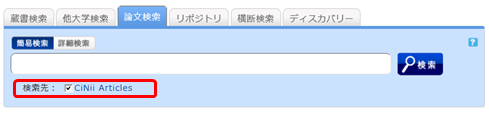
You can search for domestic academic articles. (Links to CiNii Articles)
Please enter a keyword into the search box to perform a search.
You can navigate to the CiNii Articles top page via the search link.
About the [Repository] tab
An institutional repository is a system that systematically collects, preserves, and widely publishes electronic intellectual products created within an institution (such as academic journal articles, theses, research reports for grants, lecture materials, teaching materials, conference presentation materials, etc.) on the institution's server.
Please enter a keyword into the search box to perform a search.
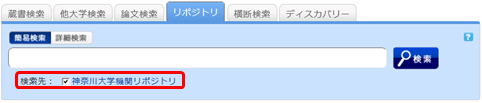
You can navigate to the Kanagawa University Institutional Repository top page via the search link.
About the [Cross Search] tab
From the [Cross Search] tab, please check the libraries or other institutions you wish to search and perform your search.
How to use
- On the search results list screen, you can display search results for each individual target site or the combined search results for all sites.
- The search results from the site that finishes the search the fastest are displayed first.
- To view search results from other sites, please select them from the menu on the left.
- You can display the list of results for each specific search target by clicking "Show all sites" at the top left of the screen, or by clicking the link for each site in the site-specific search results on the left side of the screen.
Notes
- There is a limit to the number of records retrieved per site (10–100 records). If you wish to see all search results for a specific site, please search that site directly.
- The results from [Cross Search] may differ from those obtained by searching the target site directly. Please use [Cross Search] as a guide to determine which site you should use to find the materials you are looking for.
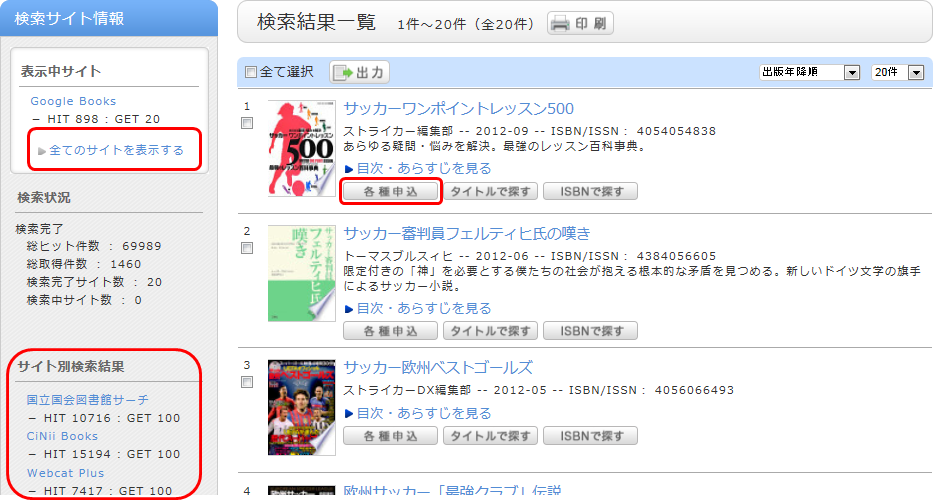
By selecting "Various Requests" displayed for each bibliographic record on the search results list screen, you can place an ILL photocopy request (requesting copies) or an ILL loan request (requesting books).
I found an item in the OPAC, but I don't know where it is located on the shelves.
In the holding information of your search results, there is a field called "Call Number."
When you hover your cursor over this link, an image of the call number label will be displayed.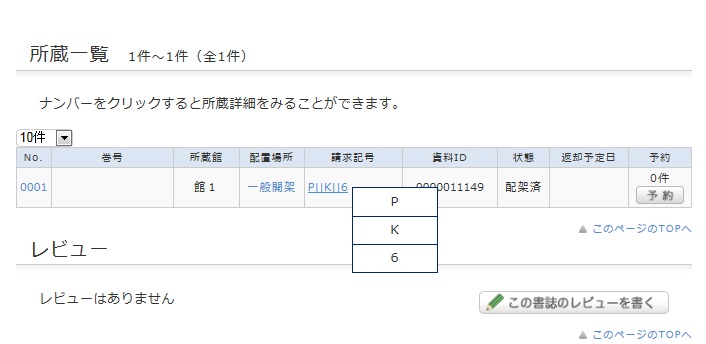
This image corresponds to the label attached to the book.
Books in the library are arranged on the shelves in the order of these call numbers.
Please use the library floor guide and this number to locate the bookshelf where the book is shelved.
What should I do if the material I found in the OPAC is currently checked out?
You can reserve materials that are marked as "Checked out" in the library catalog by following the steps below.
1. Click the [Reserve] button under "Holdings List" on the bibliographic details screen.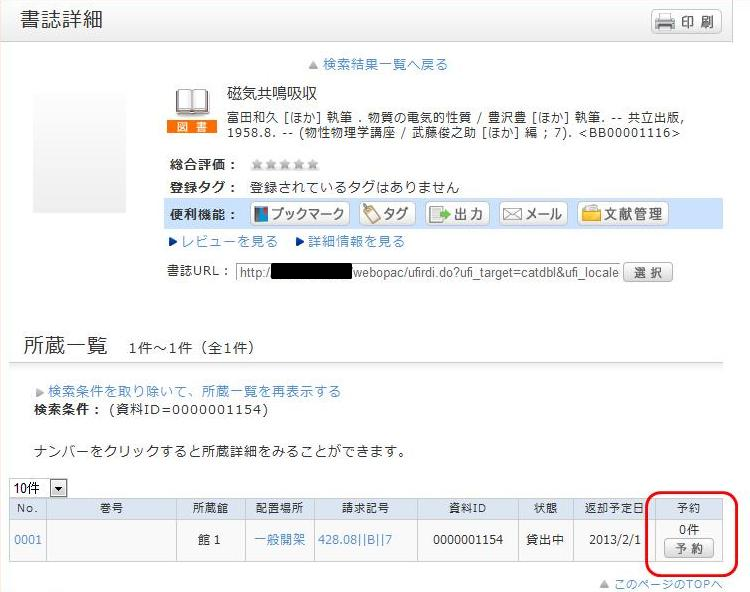
2. On the request condition selection screen, select your desired request conditions and click [Select].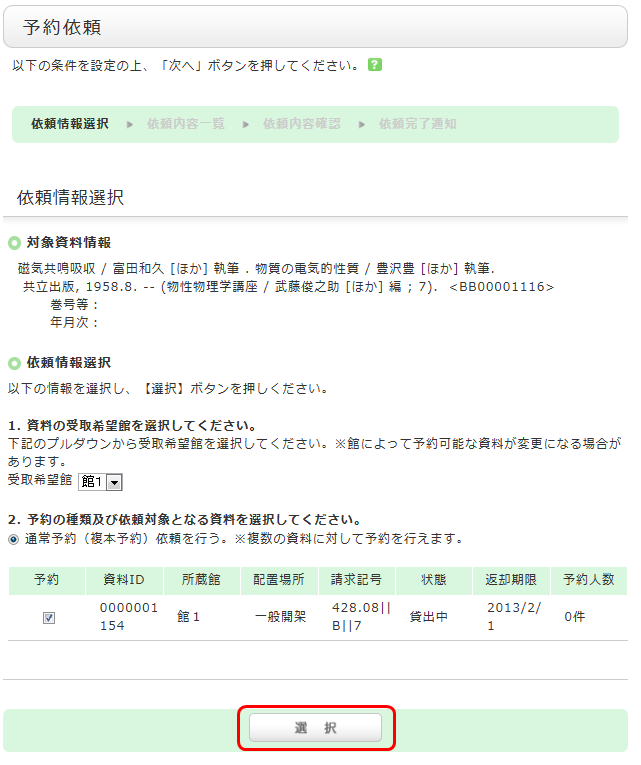
3. On the request information entry screen, confirm the material and applicant information, enter (or verify) the reservation details, and finally click [Apply].
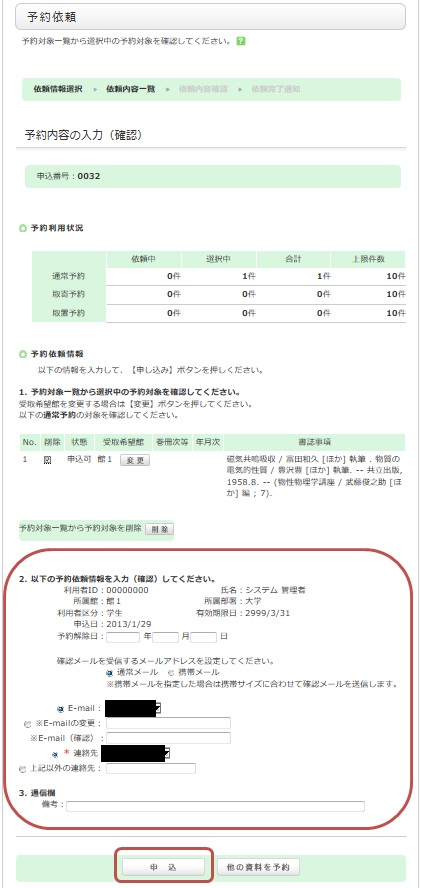
4. Confirm the reservation request details on the "Request Confirmation" screen and click [Confirm].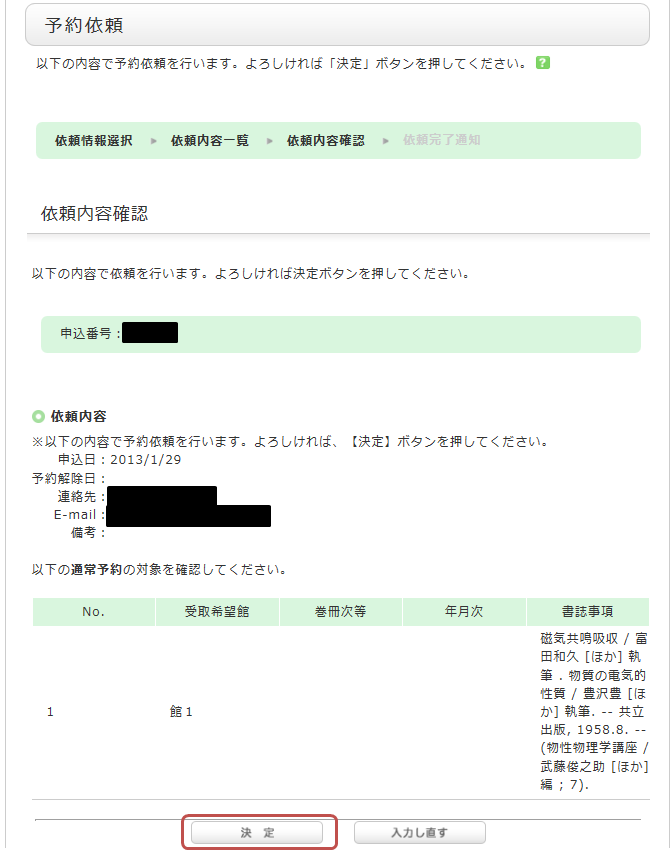
5. The reservation is complete once you see the "Request Completion Notice" screen.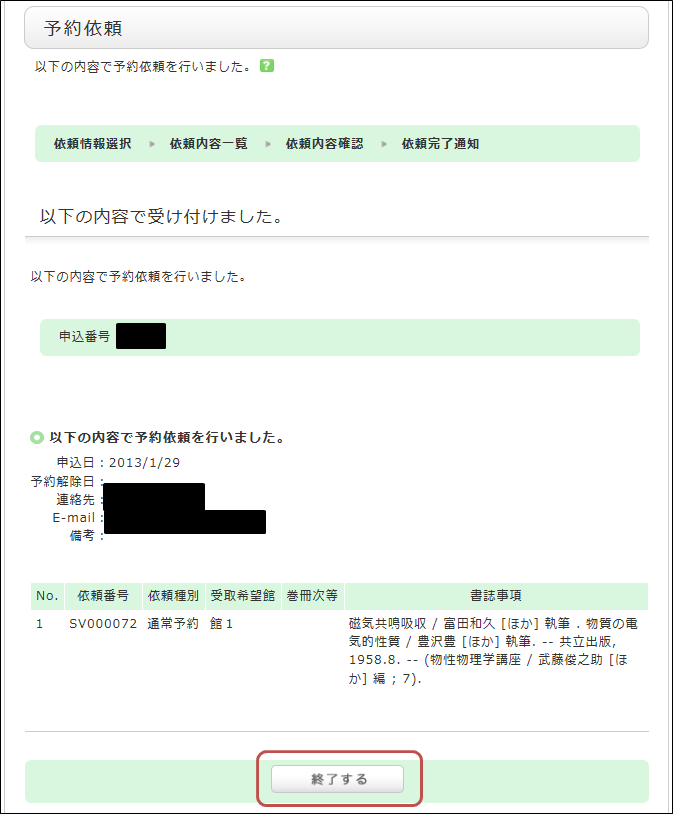
*An automated notification email will be sent to your university email address when your reserved item arrives. The hold period is 1 week.
What if there is material I want to use at a nearby public library?
Please refer to the page below.
How to Find Materials (Library Website)
What if there is material I want to use at another university library?
The [Search Other Universities] tab allows you to search for books and journals held primarily by university libraries in Japan.
Please note that you cannot search for articles here. If you wish to search for articles, please use the [Article Search] tab.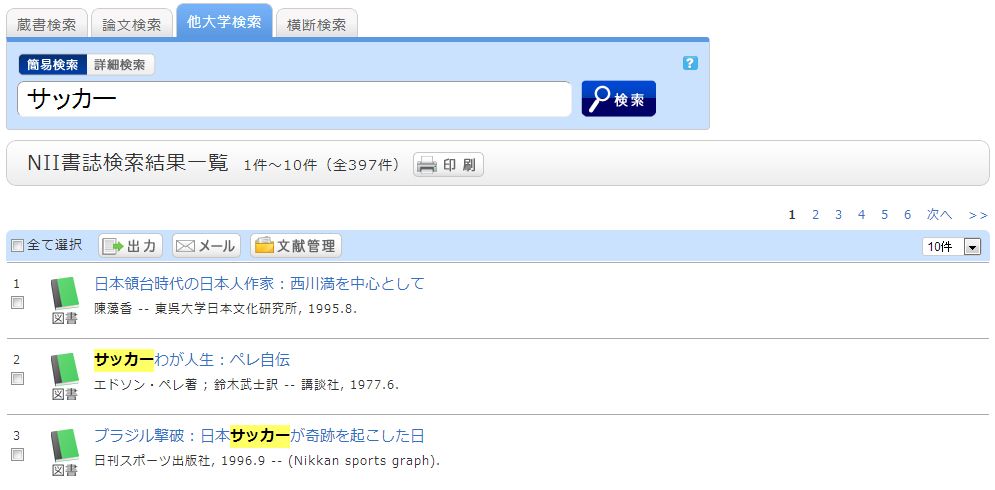
Enter a keyword to perform a search, and the search results list screen will be displayed. Selecting a material from the list will display the NII bibliographic details screen.
On the menu on the right side of the screen, under the "Borrow from Other Institutions" section, please click on one of the following:
- ILL Photocopy Request (Requesting a copy)
- ILL Loan Request (Borrowing the actual item)
An ILL Photocopy Request is a service for obtaining copies of articles or parts of books from other university libraries or institutions.
An ILL Loan Request is a service for borrowing actual books from other university libraries or institutions.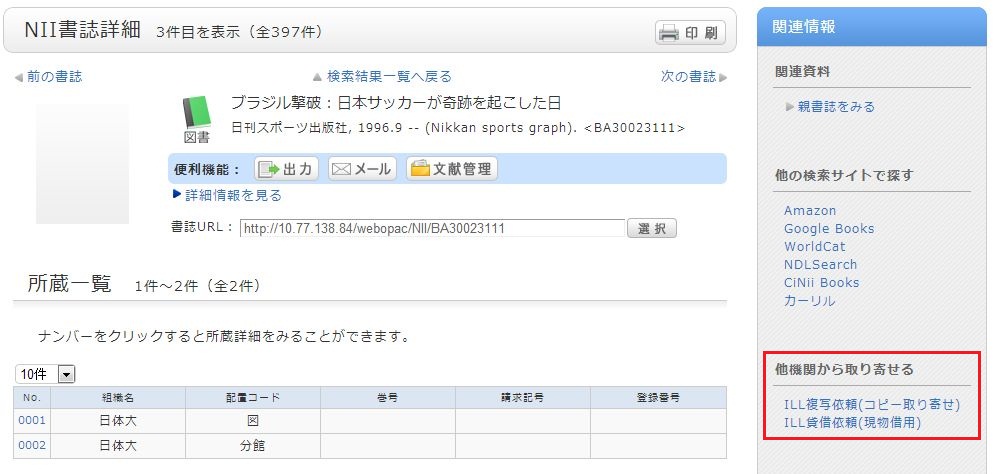
There is an article I want to obtain, but I couldn't find it. Are there ways to get it?
If you already have detailed information about the article, please enter the material details via the "ILL Photocopy Request" link on the left side of the screen.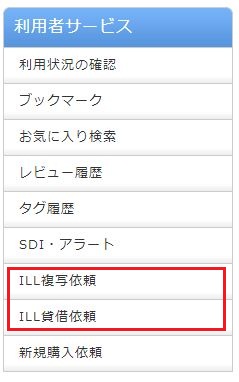
If you know that a specific journal is held by another university, please select the [Search Other Universities] tab from the search box, and select "ILL Photocopy Request" from the details page of the relevant journal (NII bibliographic details screen).
If you have found the information in another system, please follow the instructions in that system's help section to place an ILL photocopy request.
Please tell me how to fill out the photocopy request form.
1. First, enter the information for the material you are looking for.
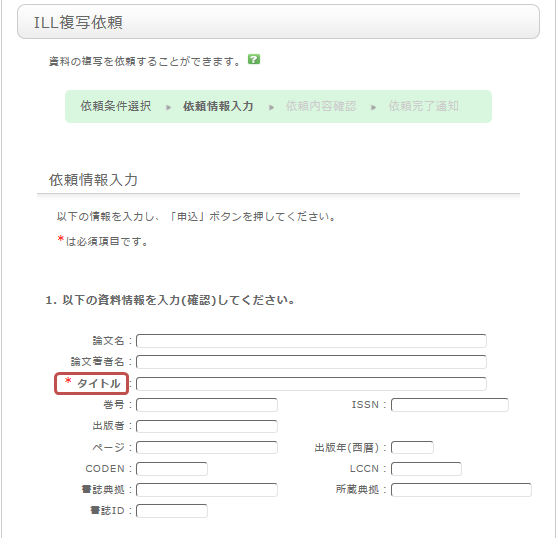
To ensure that you receive the material, please provide as much detail as possible. If you found the information in a database system, etc., please include the name of that system in the "Bibliographic Source" field.
* Please note that the screen above is for requesting a journal article. The screen will look different for books.
2. Next, enter your own information under "Applicant Information."
Please ensure that your contact information is correct, as errors may prevent us from delivering the material to you promptly. Please provide contact details where you can be reached.
3. Next, enter the request-related information, payment method, and any remarks.
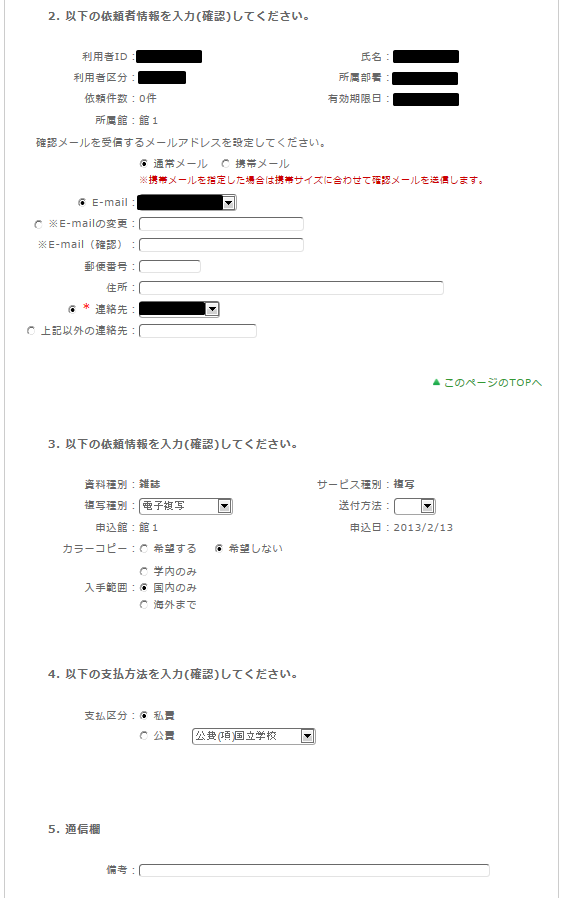
In the request-related information section, specify the photocopying method, delivery method, and the library where you wish to pick up the item. Photocopy requests are subject to a fee, so please also specify the budget limit for the request.
Please be aware that copies requested from overseas may cost more and take longer than those requested within Japan.
For the payment method, you can select "Private funds" or "Public funds." Please note that using public funds requires that you have the necessary budget available.
In the "Remarks" section, please include any additional information you need to communicate, such as specific printing instructions or individual requests regarding pick-up.
Once you have entered all the information, click the [Apply] button. After checking the details on the confirmation screen, if everything is correct, click the [Decide] button to complete your request.
How do I place an ILL (Interlibrary Loan) request?
* Please ensure that you have thoroughly searched for the material within the library before submitting a request.
1. First, enter the information for the material you are looking for.
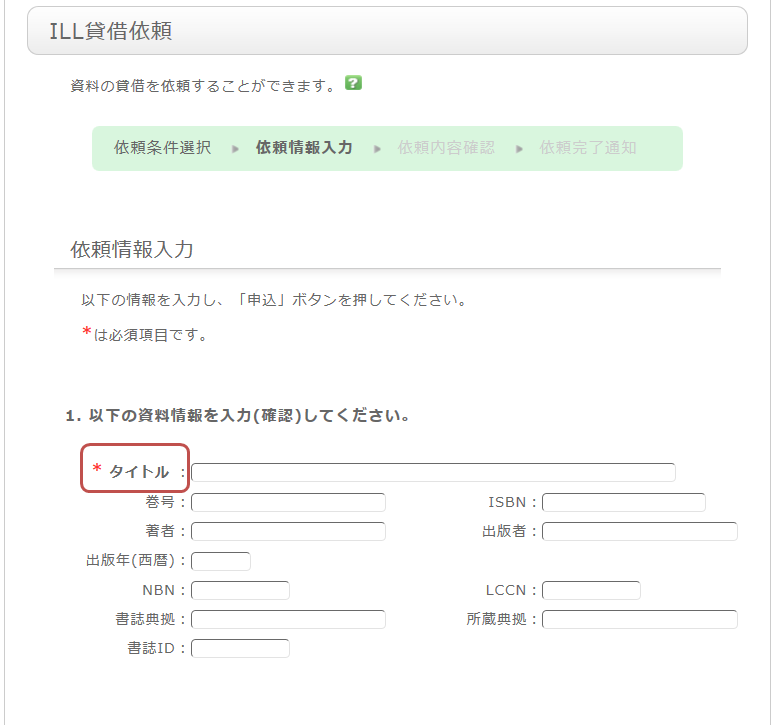
To ensure that you receive the material, please provide as much detail as possible. If you found the information in a database system, etc., please include the name of that system in the "Bibliographic Source" field.
* Bold items are required fields.
2. Next, enter your own information under "Applicant Information."
Please ensure that your contact information is correct, as errors may prevent us from delivering the material to you promptly. Please provide contact details where you can be reached.
3. Next, enter the request-related information, payment method, and any remarks.
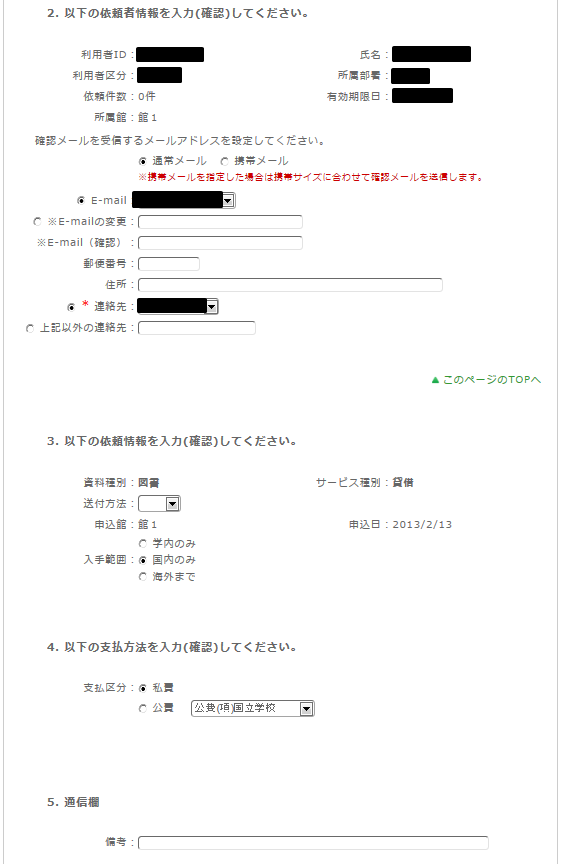
In the request-related information section, specify the delivery method and the library where you wish to pick up the item. Please also select the budget limit for the request.
Please be aware that copies requested from overseas may cost more and take longer than those requested within Japan.
For the payment method, you can select "Private funds" or "Public funds." Please note that using public funds requires that you have the necessary budget available.
In the "Remarks" section, please include any additional information you need to communicate, such as "I wish to cancel if the material is restricted to library use only" or "I wish to cancel if the material cannot be copied."
Once you have entered all the information, click the [Apply] button. After checking the details on the confirmation screen, if everything is correct, click the [Decide] button to complete your request.
I requested a photocopy (ILL copy request), but how can I cancel it?
You can cancel a request from the "Check Usage Status" page.
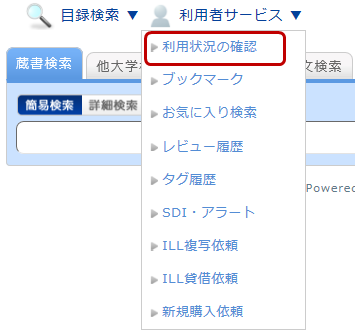
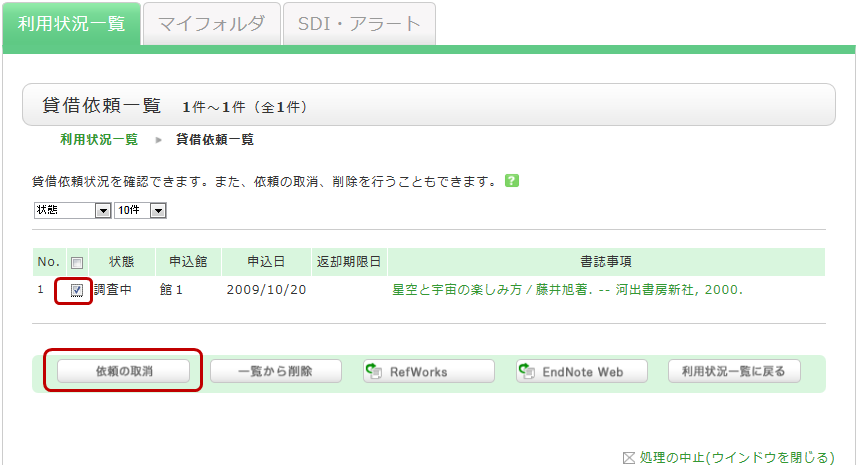
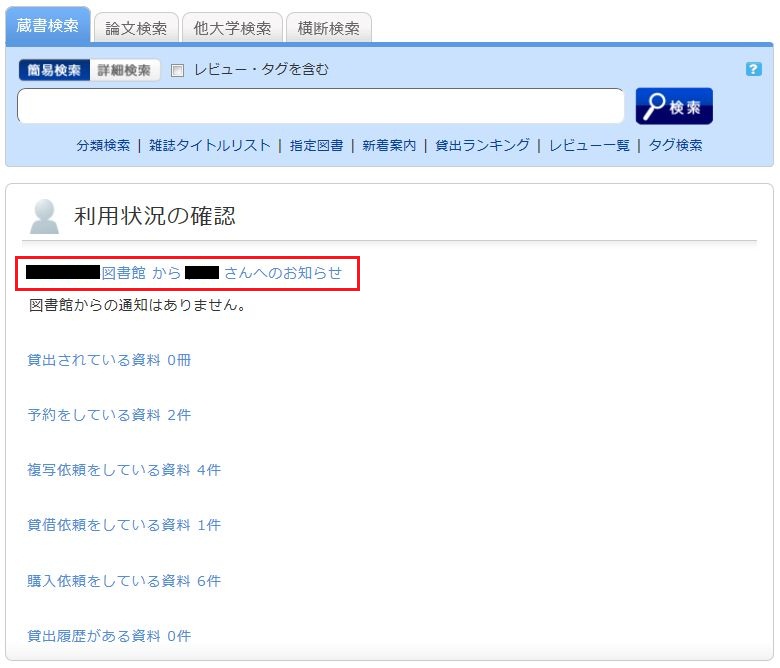
On the "Check Usage Status" screen, you can view the items you currently have checked out and the status of your various requests. Under the section for information regarding photocopy requests, select "Go to Photocopy Request List." This will allow you to view a list of your current photocopy requests. From this list, check the box for the material you wish to cancel and click the [Cancel Request] button.
How do I cancel an ILL loan request I have already placed?
You can cancel a request from the "Check Usage Status" page.
On the "Check Usage Status" screen, you can view the items you currently have checked out and the status of your various requests. Under the section for information regarding loan requests, select "Go to Loan Request List." This will allow you to view a list of your current loan requests. From this list, check the box for the material you wish to cancel and click the [Cancel Request] button.
What kind of personal services are available?
To use the Personal Service, you will need a library account.
The Personal Service is broadly divided into the following three functions:
1. Check Usage Status
This function allows you to view your current checkout status and apply for loan period extensions.
2. My Folder
This function allows you to save search conditions and search results, and to view your tag and review history.
3. Alert
This function notifies you when new books or journals arrive at the library.
I cannot log in to the OPAC.
You need an MNS account to log in to the OPAC user services.
What can I do in the "My Account" (Usage Status) list?
Loans
You can select items by checking the checkboxes in the list to renew loans or export them to bibliographic management tools.
Clicking on the title of a bibliographic record allows you to view its detailed status.
Reservations
You can select items by checking the checkboxes in the list to cancel reservations, delete them from the list, or export them to bibliographic management tools.
Clicking on the title of a bibliographic record allows you to view the detailed status of the reservation.
Copy Requests
You can select items by checking the checkboxes in the list to cancel requests, delete them from the list, or export them to bibliographic management tools.
Clicking on the title of a bibliographic record allows you to view its detailed status.
ILL Requests
You can select items by checking the checkboxes in the list to cancel requests, delete them from the list, or export them to bibliographic management tools.
Clicking on the title of a bibliographic record allows you to view the detailed status of the request.
Loan History
You can select items by checking the checkboxes in the list to delete them from the list or export them to bibliographic management tools.
Clicking on the title of a bibliographic record allows you to view the details of your loan history.
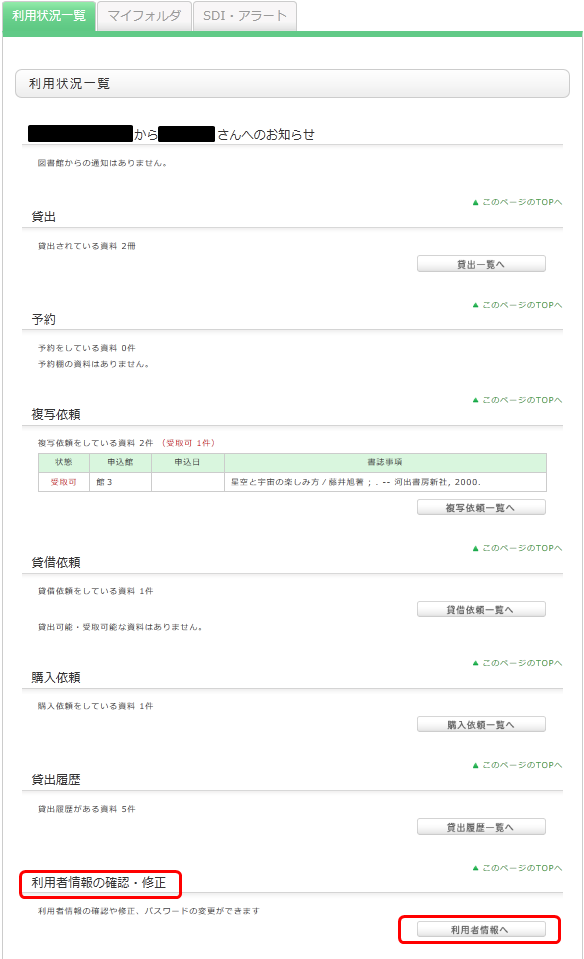
View/Edit User Information
Please note that you can only view your user information and cannot modify it.
How can I update my user information in the OPAC?
You can check your registered information from "My Account" > "User Information" in the OPAC. Please note that you cannot modify this information.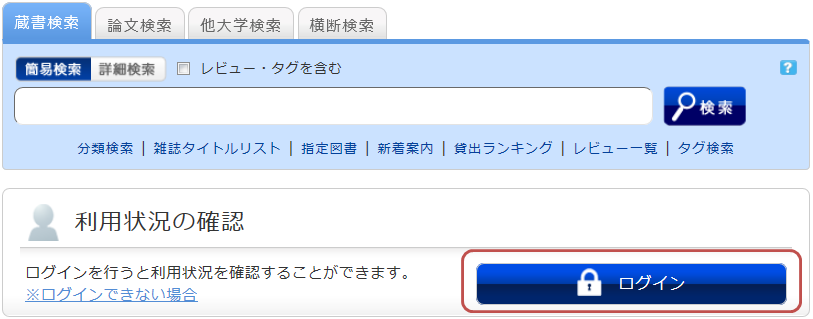
What features does "My Folder" offer?
The following features are collectively referred to as "My Folder" functions.
1. Bookmarks
This feature allows you to create a list of materials on the web. You can register books you have already read or those you plan to read in the future.
It can also be used as a list for exporting data to EndNote or RefWorks.
2. Favorite Searches
This feature allows you to save search criteria. You can use the same search criteria for future searches.
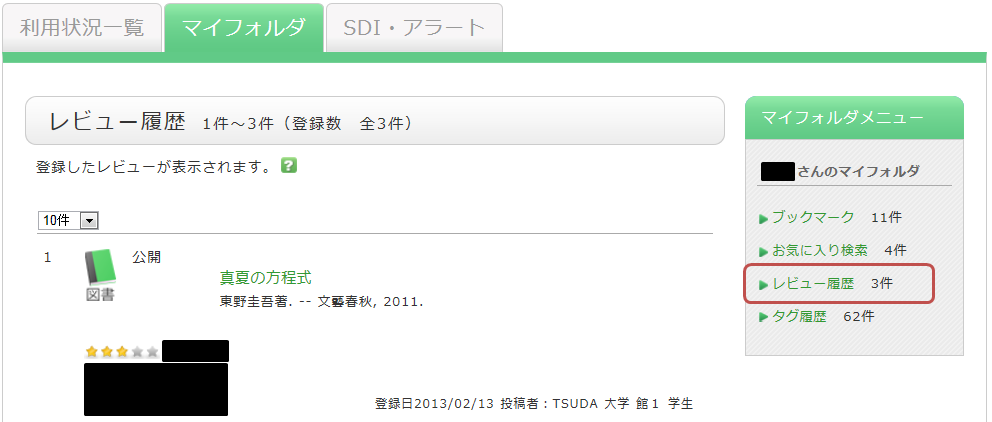
3. Review History
This feature allows you to view the history of reviews you have written.
Is it possible to save a list of materials to check later?
Materials you have searched for and viewed details of in the library catalog are recorded as "Browsing History" until you close your browser (or remain inactive for an extended period).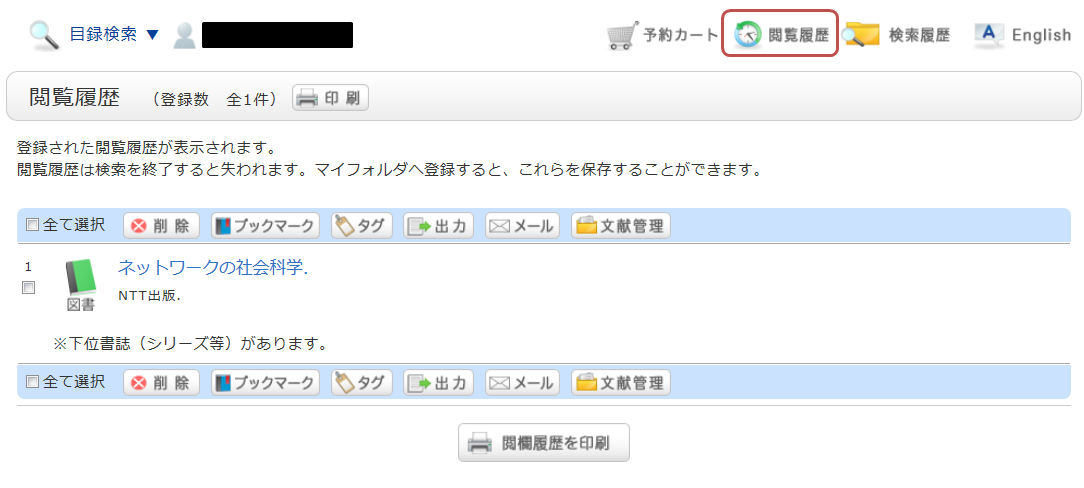
*The image shows the screen after clicking "Browsing History."
If you wish to view these materials at a later date, please add them to your bookmarks.
You can add items to your bookmarks from the search results list or the bibliographic details screen.
On the list screen, check the checkbox for the material you wish to register and click the "Bookmark" button.
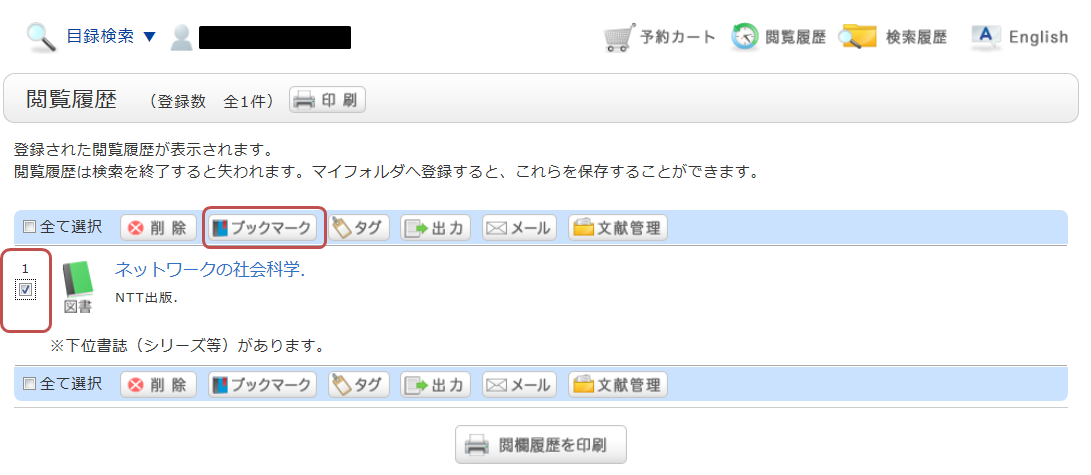
You can view your registered items from "Bookmarks."
Is it possible to save search criteria for future use?
Search criteria entered in the OPAC library catalog are recorded as "Search History" until you close your browser (or remain inactive for an extended period).
You can view your search history by clicking the "Search History" button at the top of the screen.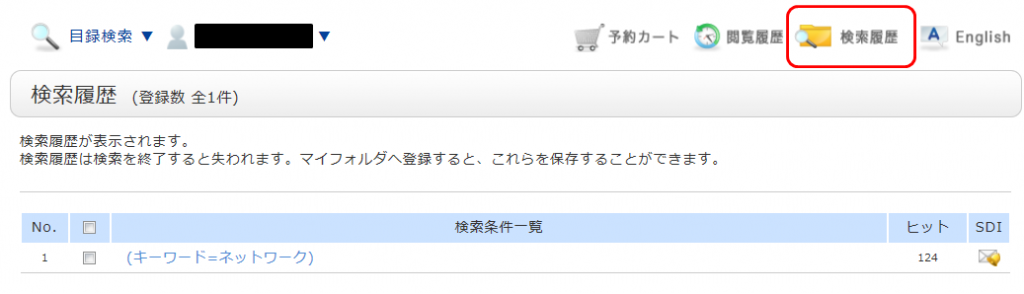
*The image shows the screen after clicking "Search History."
If you wish to save your search criteria for later use, check the checkbox for the criteria you want to register on the search history screen and click the "Add to Favorites" button.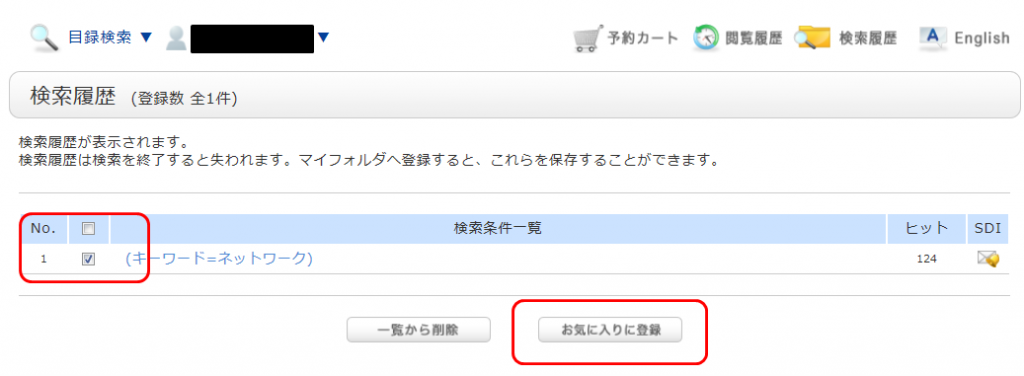
You can view your registered items from "Favorite Searches" in the OPAC.
Can I be notified when a new issue of journal "○○" arrives?
We provide an alert service that notifies you via email or RSS when new issues of journals arrive.
You can sign up for the alert service from the bibliographic detail screen.
Please note that this service applies only to journals that are currently being received.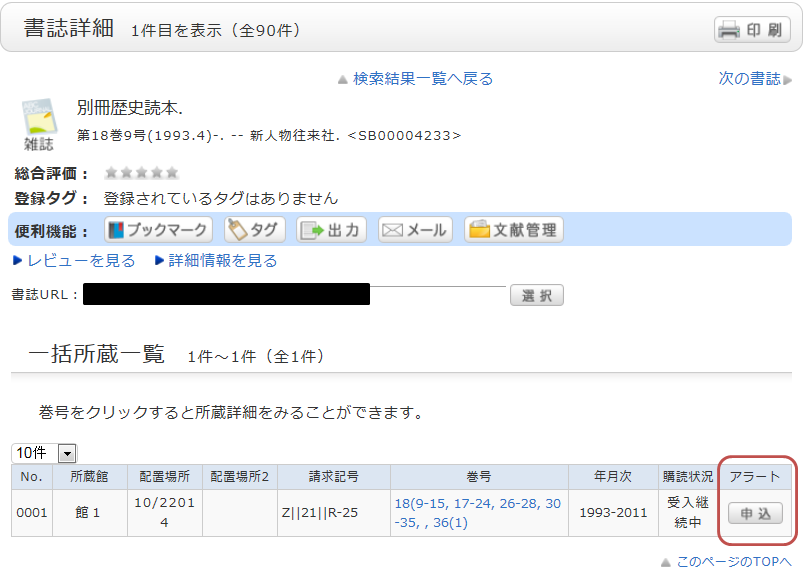
Once your request is complete, the registered conditions will be displayed on the alert list screen.
On the alert list screen, you can stop notifications or change the delivery frequency.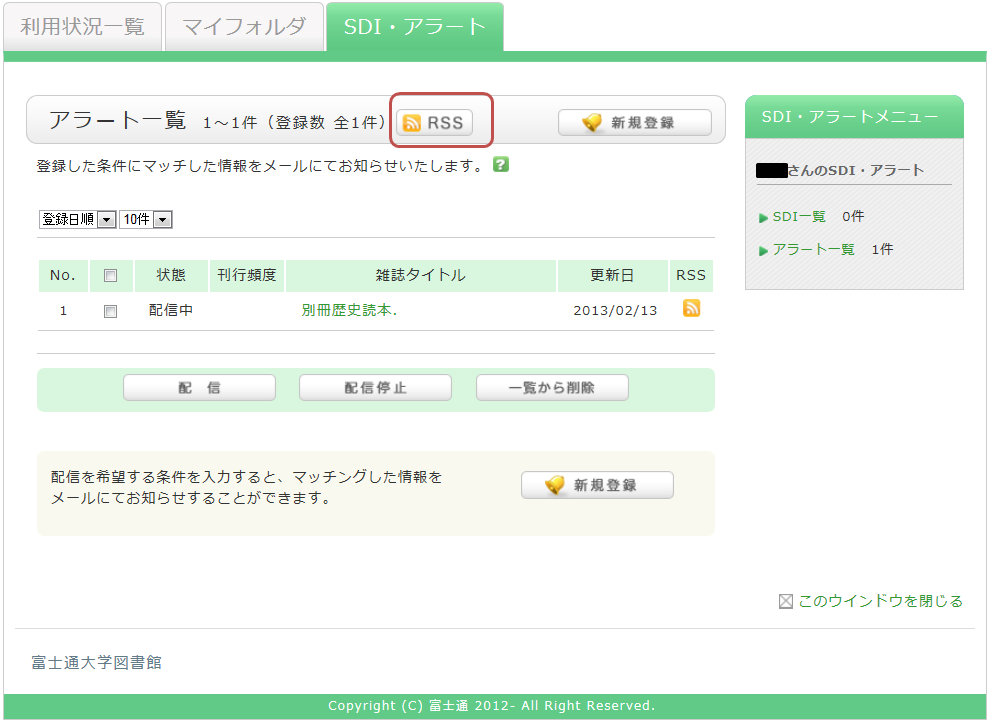
You can also register with an RSS reader by clicking the "RSS" button.
By registering with an RSS reader, you can check for new arrivals of relevant materials without having to check the OPAC.
*The following journals are not eligible for alerts. Please be aware that you will not receive notifications even if you sign up.
●Yokohama
・Items with blank volume/issue numbers
・Items located in "Basement 1F Stack," "Basement 2F Stack," or "Building 23 Stack"
●Minatomirai
・Items with blank volume/issue numbers
Can I be notified when new books related to "○○" arrive?
The OPAC offers a service called Alert.
This feature remembers your search criteria and notifies you via email, RSS, or other methods when materials matching those criteria are newly acquired.
You can register by clicking "Save Search Criteria" after performing a search in the OPAC library catalog.
Alternatively, you can also register from the "Alerts" section of the OPAC.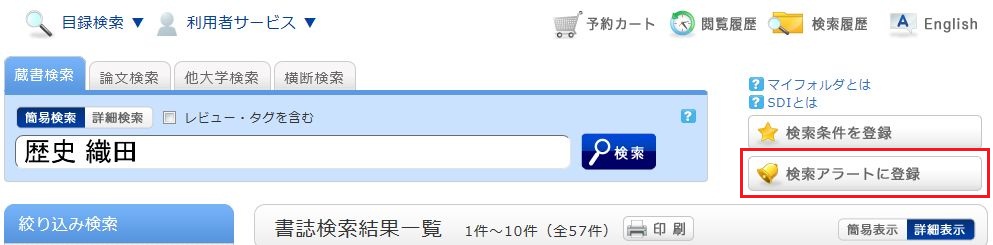
Once registered, your alert list screen will be displayed.
From here, you can view your active delivery list and change the delivery frequency.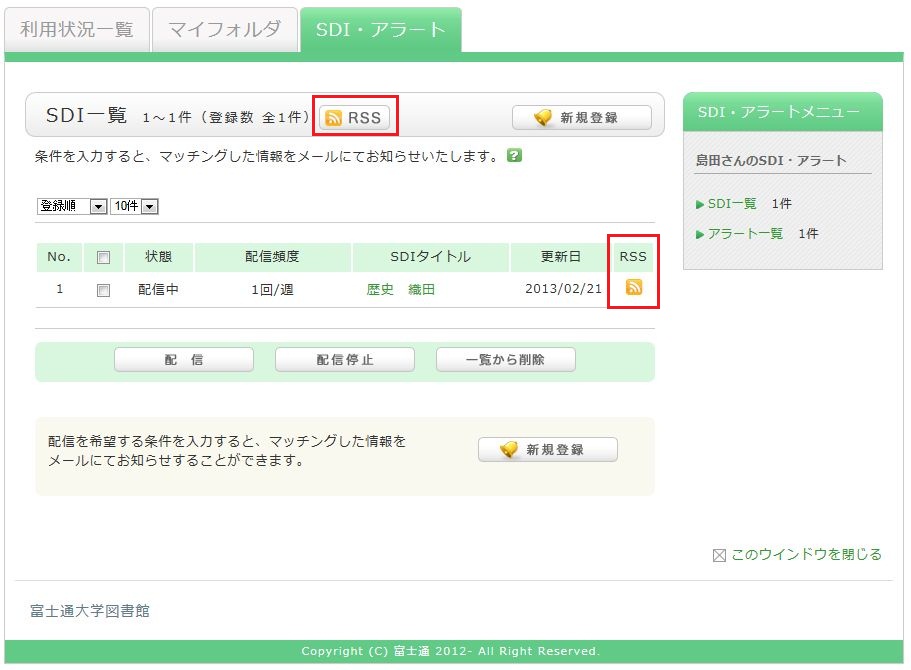
You can register for the service in an RSS reader by clicking the "RSS" button.
By registering in an RSS reader, you can check for new arrivals of the relevant materials without having to check the OPAC.
How do I register a review?
To register a review, click [Write a review for this book] on the bibliographic details screen.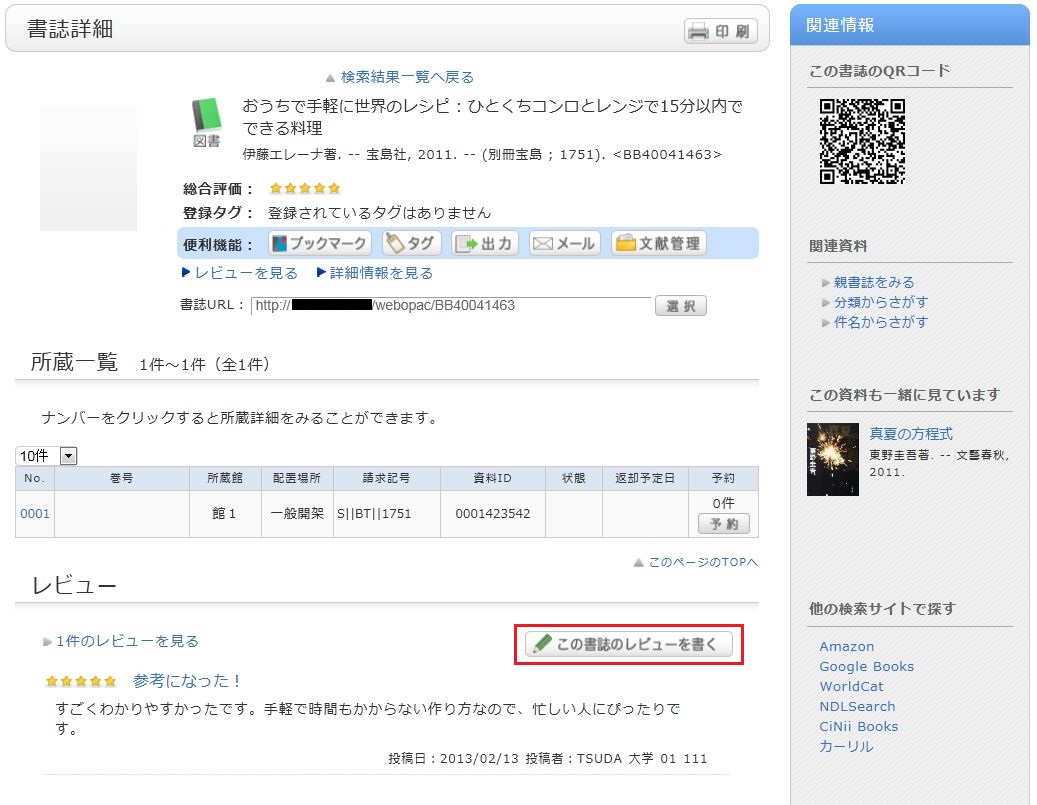
Entering a Review
- Check the bibliographic item for which you are writing a review, select a rating (1-5 stars), enter the review title and body, and click [Post].
HTML tags and machine-dependent characters cannot be used. - Review your submission details. If they are correct, click [Confirm]. If you wish to re-enter the information, click [Re-enter].
- When a review is published, in addition to the review title and body, the contributor's date of posting, department, library affiliation, and user category will be displayed.
Evaluating Reviews
You can comment on reviews, vote on their helpfulness, or report inappropriate reviews.
From the review details screen, click the following options to proceed to the input screen:
- Was this review helpful? ▶ Yes ▶ No
- Report as an inappropriate review
- Write a comment on this review

How can I check the reviews I have written?
You can check this under "OPAC > My Folder > Review History."
There is a book I would like the library to purchase.
You can submit a purchase request to the library by accessing "New Purchase Request" under "User Service" on the left side of the OPAC top page and filling out the required information (students only). The library individually evaluates whether to purchase requested materials based on criteria such as their suitability as university library collection resources and whether they will be useful to a wide range of users. Please note that not all requested materials are purchased.
I have a question, opinion, or request for the library.
Please come to the library counter.
What kind of service is the OPAC?
It is a general term for the library's catalog search system.
It is an abbreviation for "Online Public Access Catalog."
Can I use materials labeled as "Laboratory/Office" (Kenkyushitsu) in the OPAC search results?
Please note that materials located in research institutes cannot be accessed through the library.
Examples include the Institute of Economics and Trade, the Center for Language Research, the Institute for the Humanities, and the Institute for the Study of Japanese Folk Culture.
What should I do if I cannot find the material I'm looking for in the [Book Search] tab? (Part 1)
If you cannot find any results when searching via the [Library Catalog] tab in the OPAC, please try the following:
- Check if the kanji or spelling of your keywords is correct.
- Are you perhaps searching by "article title" or "author of the article"? Try searching by the journal title instead.
If you wish to search by "article title" or "author of the article," please try searching via the [Article Search] tab. You may be able to read the full text of electronic journals on your computer. - If you still cannot find the material, try searching via the [Search Other Universities] tab or the [Cross-Search] tab.
If you can confirm that another library holds the material, you may be able to visit that library in person to use it, or request to have the material sent to your library.
What should I do if I cannot find the material I'm looking for in the [Book Search] tab? (Part 2)
Please refer to the following page.
How to Find Materials (Library Website)
How can I extend the loan period of the books I have borrowed?
You can check the materials you have borrowed from the university libraries and renew your loans via the OPAC.
1. First, log in to the OPAC.
2. After logging in, click "Borrowed Materials" under "Check Usage Status."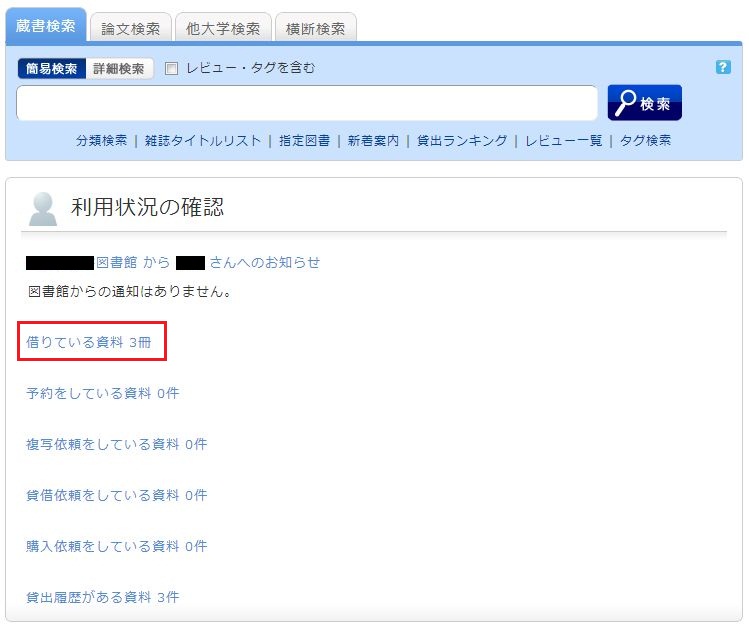
3. Once the "Loan List" is displayed, check the box next to the material you wish to renew and click [Renew Loan].
In the "Loan List," you can confirm your current loan status, including where you borrowed the item (Library), what you borrowed (Bibliographic details), and the due date (Due Date).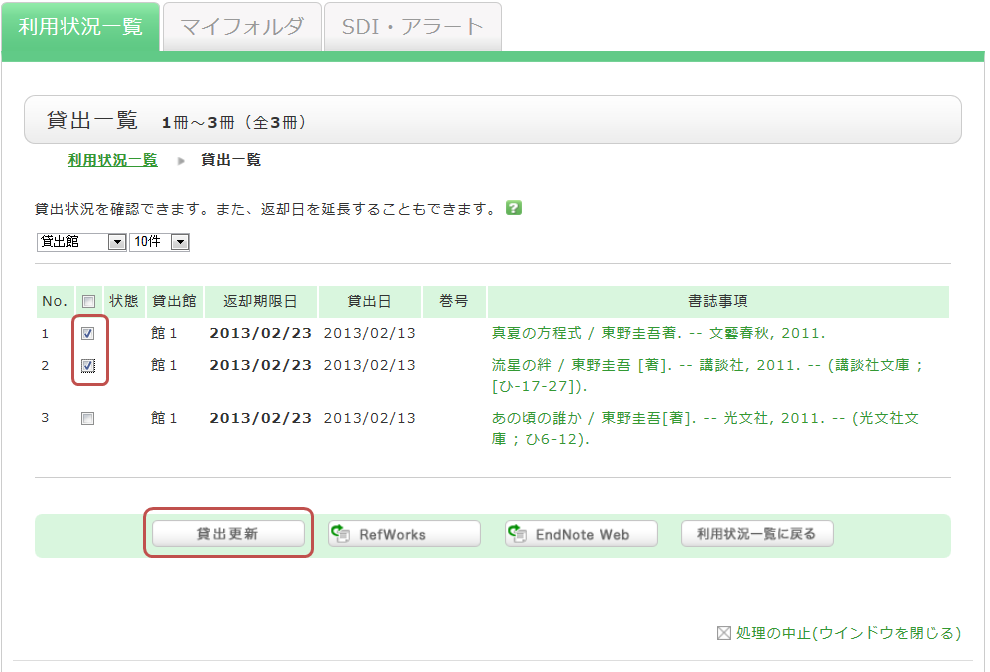
4. Click [OK] in the pop-up window.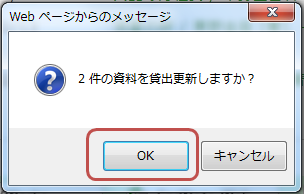
5. The due date will be extended, and the renewal is complete.
If the renewal fails, the reason will be displayed.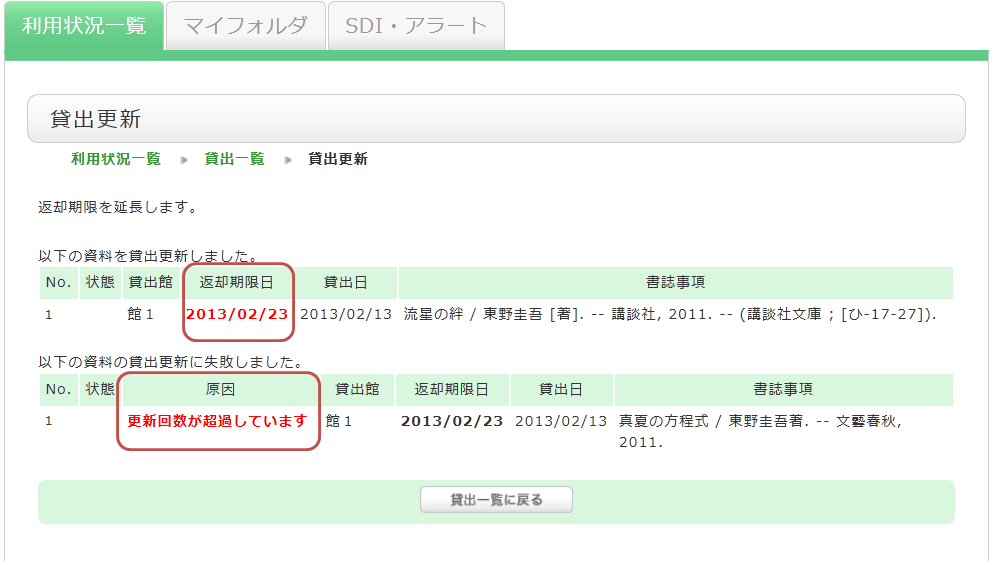
Clicking on the "Bibliographic details" of a borrowed item in the "Loan List" will display the "Bibliographic Details" screen, where you can check information such as the number of times the item has been renewed.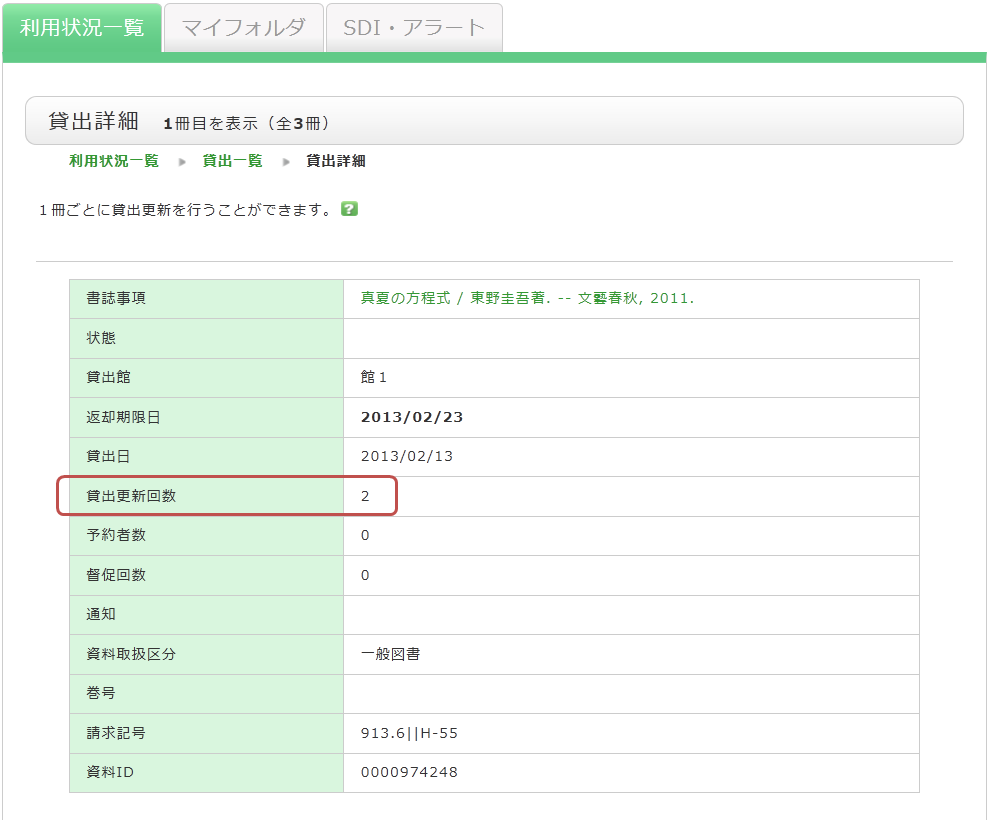
Please note the following regarding loan renewals:
- The new due date is calculated based on the online renewal rules of the library that holds the item.
- Online loan renewals are based on the date the renewal process is performed. Please note that it does not add to the loan period from the original due date.
- You cannot renew loans in the following cases:
- The material is on "Vacation Loan."
- The material has been reserved by another user.
- You have overdue materials or are currently in a loan suspension period.
- Depending on the type of material (e.g., textbooks, journals), some items may not be eligible for renewal.
How do I cancel a reservation?
If you wish to cancel a reserved item, you can do so via the OPAC.
1. Log in to the OPAC.
2. From "Check Usage Status" on the OPAC top page, click "Reserved Materials."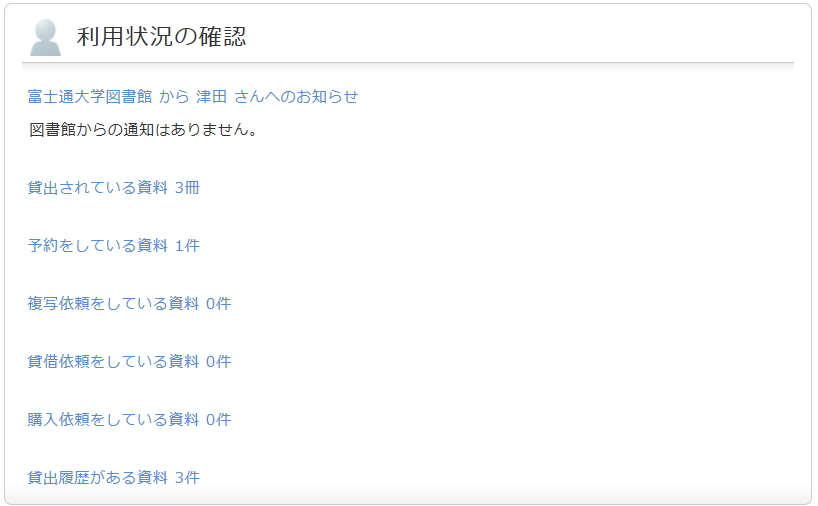
3. Once the reservation list screen is displayed, check the box next to the material you wish to cancel and click [Cancel Reservation].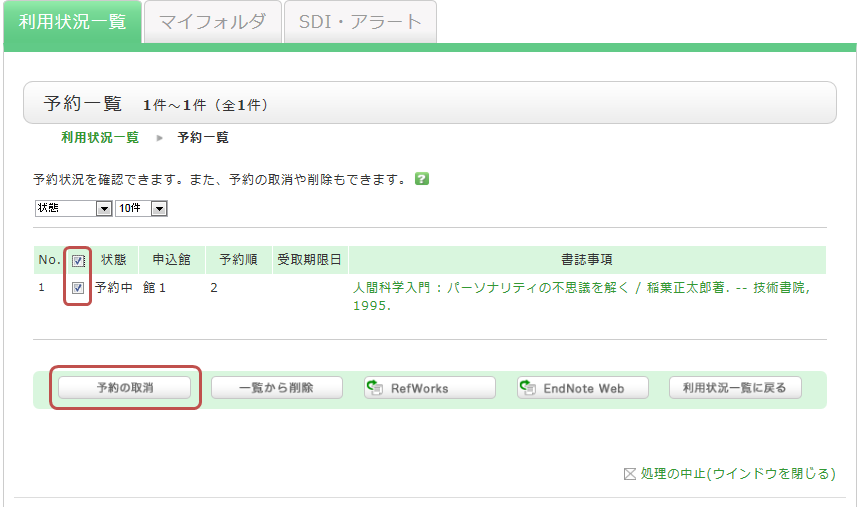
4. Click [OK] in the pop-up window.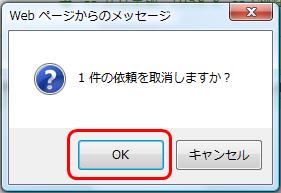
5. Once the cancellation is complete, "Cancelled" will be displayed in the status field.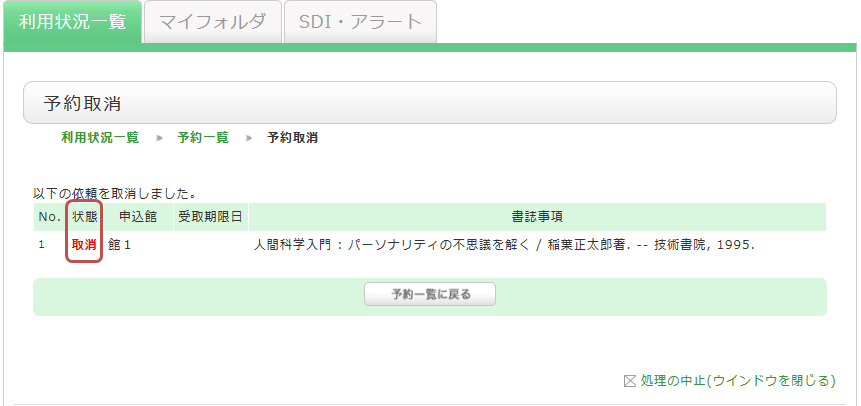
What happens if I have overdue items or my borrowing privileges are suspended?
If you have not returned materials past their due date, or if your borrowing privileges are suspended because you returned materials late, you will not be able to reserve new items or renew your current loans.
Please make sure to return all materials by their due date.
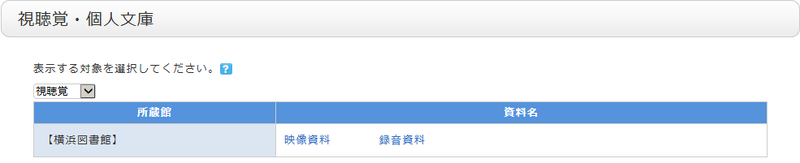
About "Audiovisual/Personal Collections" found under the keyword input box in the [Book Search] tab or in the catalog menu.
We provide lists for categories that are frequently requested to be viewed as a whole, even though they cannot be searched using secondary keys such as location.
You can also change the display target using the pull-down menu.
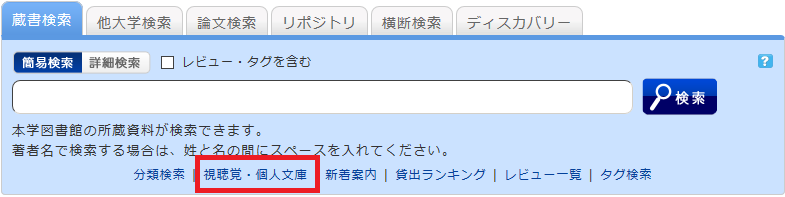
What are the tags displayed on the tag search screen?
The library provides tags for materials that are useful to have in list form, such as textbooks and materials selected during student selection tours.
How can I search for reviews and tags?
You can search the titles and full text of reviews and tags using the following five methods:
- Refer to "Recent Tags"
 or "New Reviews"
  on the top page.
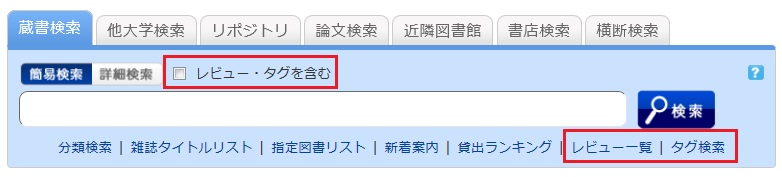
- Select "Review List" or "Tag Search" located below the search box on the [Library Catalog] tab.
- On the [Basic Search] screen of the [Library Catalog] tab, check the "Include Reviews/Tags" box and perform a search.
- On the [Advanced Search] screen of the [Library Catalog] tab, select "Review" or "Tag" from the pull-down menu for the search items.
(Compared to a basic search, this allows you to search using multiple conditions.)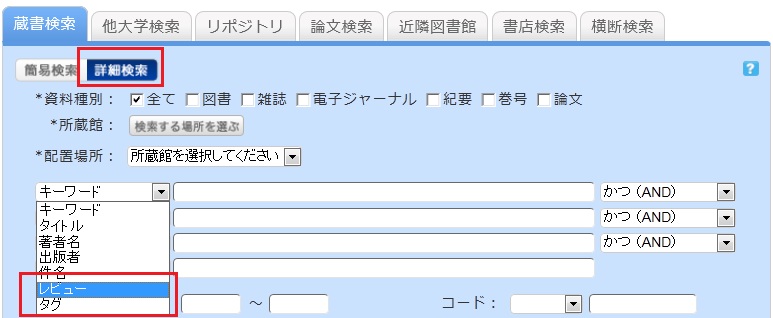
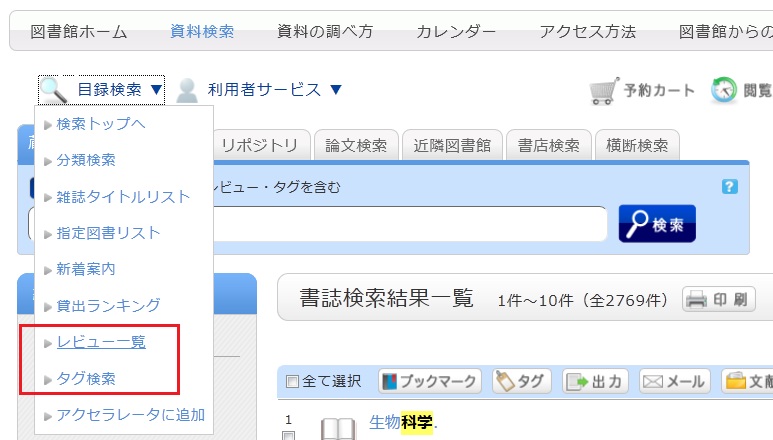
- Select "Review List" or "Tag Search" from the catalog search menu.
On the search results list screen, how do I return to the original list after narrowing down my search using the left-hand menu?
When you enter keywords and filter your search results using the menu on the left side of the bibliographic search results screen, the screen will appear as follows.
In this example, the material type is limited to "Book."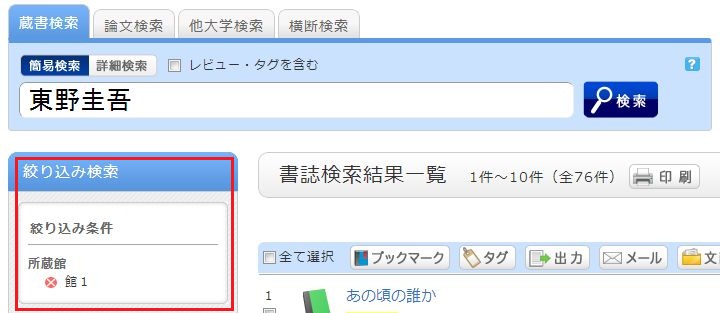
To remove a filtering condition and return to the original search results, click the red × button in the white area located under "Filtered by" in the left menu.
Even if you have applied multiple filters, you can remove any specific filter using the method above, regardless of the order in which they were applied.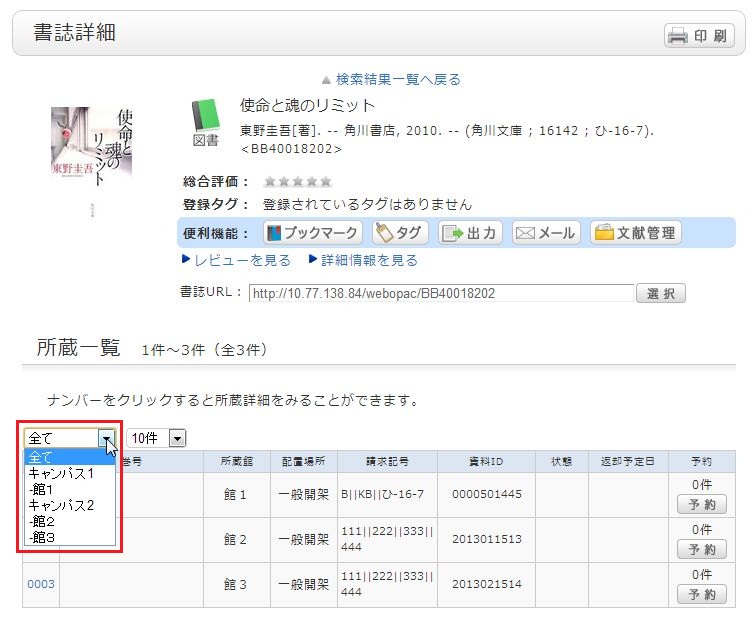
Even after you have filtered by library, selected a title, and moved to the bibliographic details screen, you can still remove the filter or re-filter by another library.
How do I import bibliographic information from the OPAC to EndNote Web?
You can import bibliographic information from the OPAC into EndNote Web.
- How to import bibliographic information directly from the OPAC to EndNote Web (Direct Import)
(You must download the plug-in before importing.)- Log in to EndNote Web.
* If you do not have an EndNote account, please register a new user account via "Register for an account."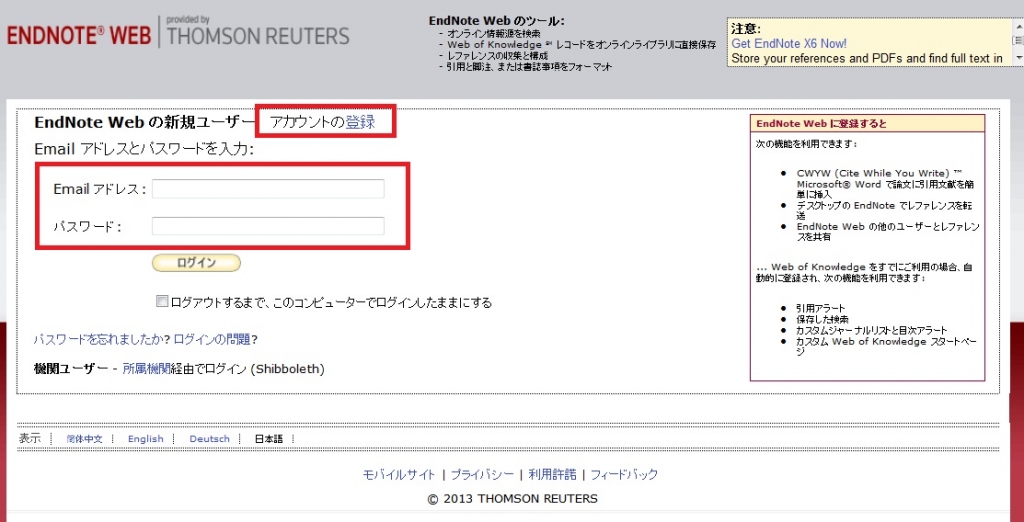
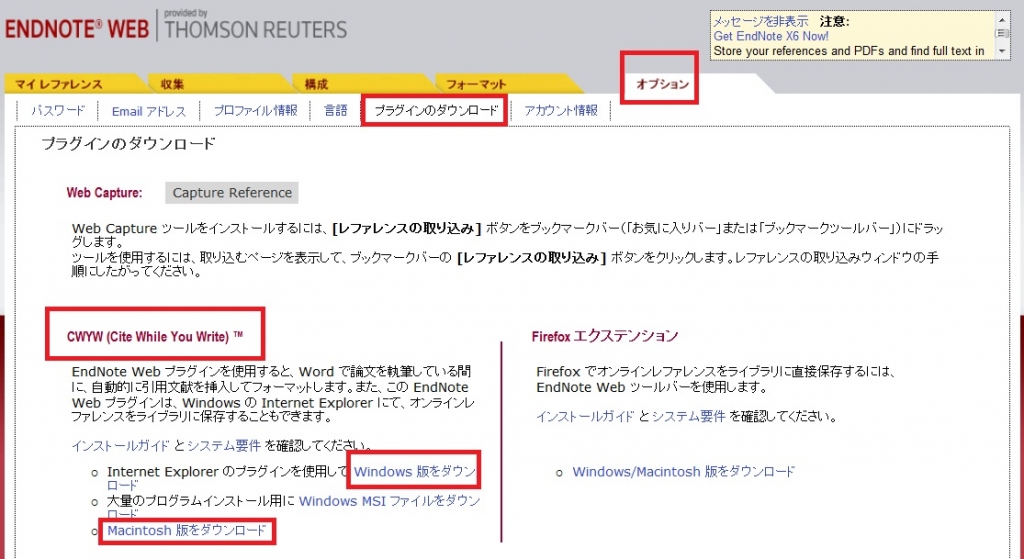
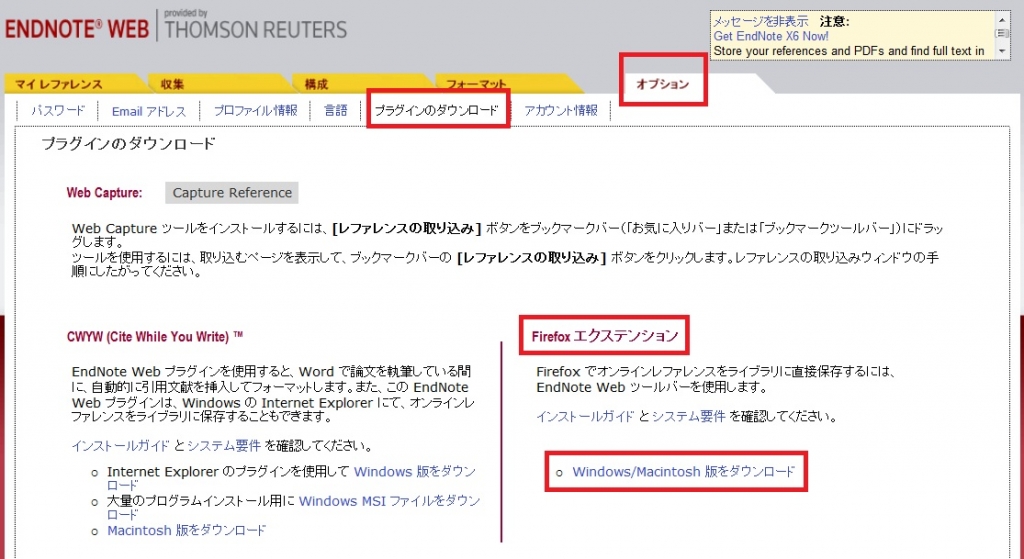
- Click [Options] > [Download Installers].
- If you are using Internet Explorer or Safari, select "Download Windows" or "Download Macintosh" under CWYW (Cite While You Write) based on your computer's OS to download the plug-in.
- If you are using Firefox:
- Click "Download Windows" or "Download Macintosh" under Firefox Extension to download the plug-in.
- You will be prompted to restart Firefox; please do so.
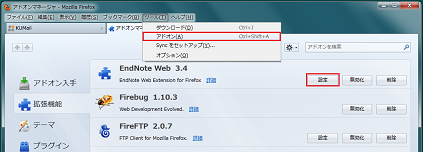
- In the Firefox menu, go to [Tools] → [Add-ons] → [Extensions] and click "Options" for EndNote Web.
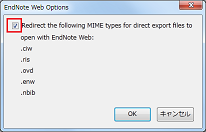
- Confirm that the checkbox in the pop-up is checked. (If it is not, please check it.)
This completes the plug-in download. - If you are using Internet Explorer or Safari, select "Download Windows" or "Download Macintosh" under CWYW (Cite While You Write) based on your computer's OS to download the plug-in.
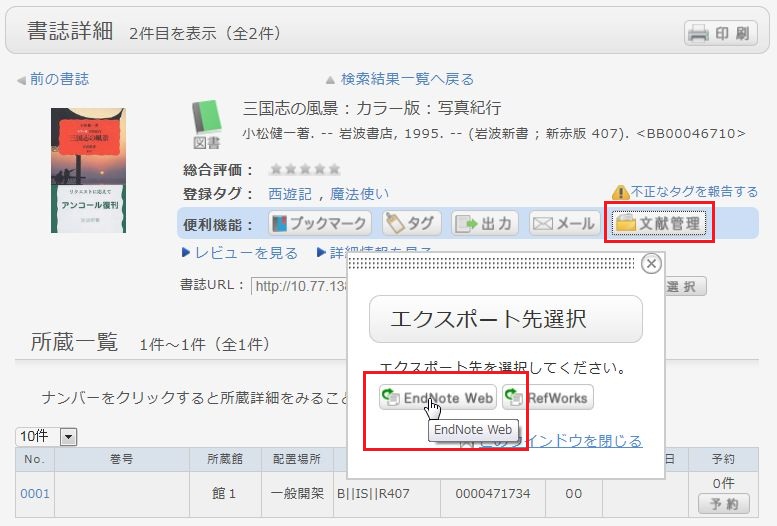
- From the bibliographic search results or details screen, click "Bibliographic Management."
(In the search results list, you must select the items you wish to import.) - When the "Select Export Destination" pop-up appears, select "EndNote Web."
- The selected bibliographic records will be imported into EndNote Web. (If you are not logged in to EndNote Web, the login screen will appear; please enter your email address and password to log in.)
- Log in to EndNote Web.
- Method without downloading a plug-in
- From the bibliographic search results or details screen, click "Export."
(In the search results list, you must select the items you wish to import.) - When the "Select File Export Format" pop-up appears, select "RIS format."
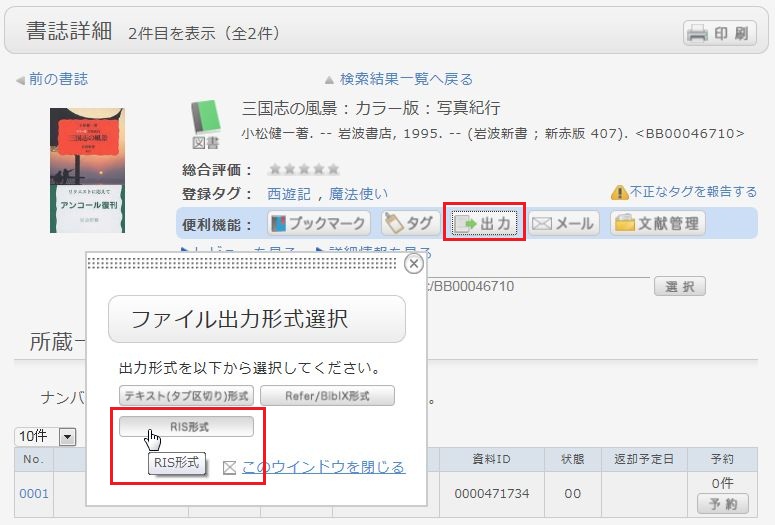
- The file will be downloaded; please save it to an appropriate location on your computer.
- Log in to EndNote Web.
* If you do not have an EndNote account, please register a new user account via "Register for an account." - Click [Collect] → [Import References].
- Click the [Browse] button for "File" and select the file you saved earlier.
- Select "RefMan RIS" for "Import Option."
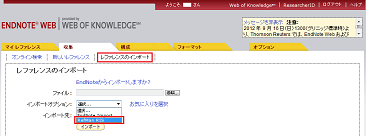
- Specify the destination folder in "Import to" and click the [Import] button.
- The selected bibliographic records will be imported into EndNote Web.
- From the bibliographic search results or details screen, click "Export."
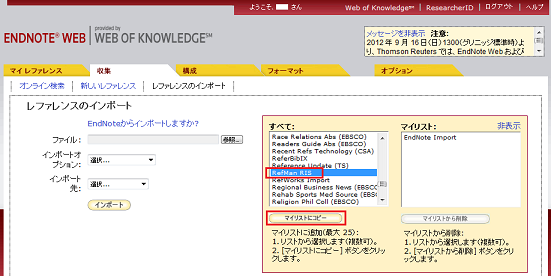
* If "RefMan RIS" is not displayed in the "Import Option," click [Select Favorites], select "RefMan RIS," and click [Copy to Favorites] to add it to your list.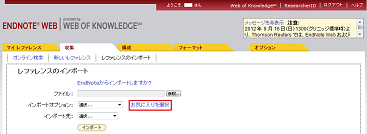
 Reference:
EndNote Web Help - Importing References
EndNote Web System Requirements (Supported Browsers)(USACO)
How do I import bibliographic information from the OPAC to RefWorks?
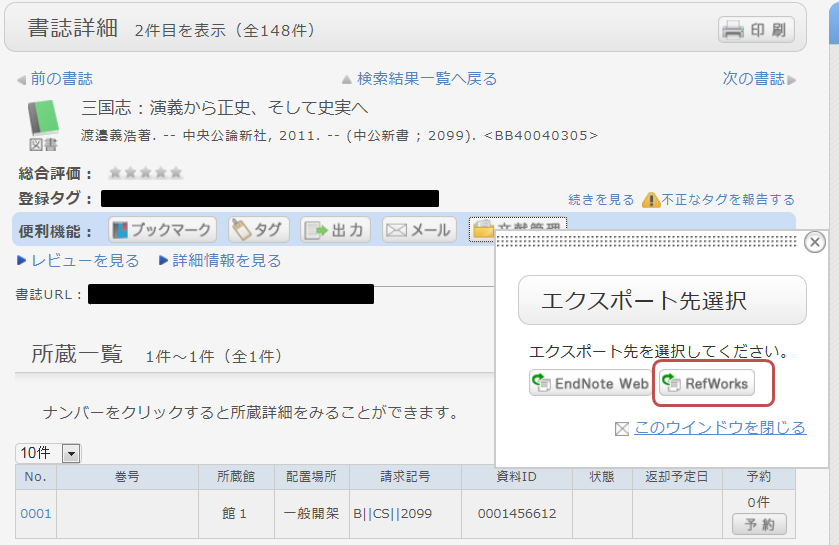
- You can import bibliographic information from the OPAC to RefWorks via the following screen.
- You can import bibliographic information from the OPAC to RefWorks via "direct import" without needing to download any plug-ins.
- Please register as a new user if it is your first time using the service.
- From the bibliographic search results or details screen, click "Bibliographic Management."
(In the search results list, you must select the items you wish to import.) - When the "Select Export Destination" pop-up appears, select "RefWorks."
- The selected bibliographic records will be imported into RefWorks. (If you are not logged in to RefWorks, the login screen will appear; please enter your login name and password to log in.)
Reference:
RefWorks (Sunmedia)
I want to copy library materials. Are there copiers available in the library?
Yes, there is. Please refer to "Copying Library Materials" on the library website.
About long-term loans.
During the summer, winter, and spring breaks, long-term loan services for general books are available (for undergraduate students only).
What should I do if I lose a book?
Please double-check to make sure you do not have the item in your possession.
In principle, you are required to compensate for any library books that are lost, soiled, or damaged.